
Grindelwald Mountain Guides Association
If you want to know where the profession of mountain guiding originated, Grindelwald is the place to be. This is where alpine history begins, and it's still being written here today.
Quality, Responsibility, and True Craftsmanship
The Grindelwald Mountain Guides Association is the professional organization for about 80 active mountain guides. We are committed to high training standards, safe guiding, and the development of our profession.
Our responsibilities at a glance:
- We guide guests to summits, across glaciers, and through alpine routes, together with OUTDOOR, our mountain sports school in Grindelwald.
- We train aspiring mountain guides and ensure ongoing education.
- We maintain high quality: Each of our guides holds an IVBV diploma.
- We represent the interests of our members both locally and nationally.
- We operate three mountain huts in the region.
- We are involved in community life and cultural events in Grindelwald.
If you take a guided tour in Grindelwald, there's a good chance you'll be with a member of our association.
History of the Grindelwald Mountain Guides Association
The Beginnings
Before travelers discovered the mountains, many Grindelwald residents lived as glacier herders. They drove their animals to the alpine pastures on the Lower Grindelwald Glacier, Zäsenberg, or Stieregg. This knowledge of routes, passes, and safe spots on the ice laid the foundation for later guiding guests through the terrain.
From the late 18th century, naturalists, traders, and early travelers came to the valley. They wanted to see the glaciers and explore the mountains. The mountain guides were the only ones who knew the way, and thus a new profession began.
1826: First Documented Guiding
In 1826, glacier herders Peter Baumann (1800–1856) and Ulrich Wittwer (1794–1868) guided a guest from Germany over the Finsteraarjoch to the Grimsel Pass. Two years later, they were involved in the first ascent of the Jungfrau from Grindelwald.
On this tour, they discovered the Eiger Cave on the mountain's backside. For the time, it was a valuable shelter: protected, dry, and close to the goal. Baumann and Wittwer are thus considered the first Grindelwald mountain guides mentioned in alpine literature (1826).
From Side Income to Profession
Initially, guiding guests was a welcome additional income for mountain guides, supplementing the meager earnings from agriculture. However, with the growing enthusiasm of English alpinists from the mid-19th century, it developed into a standalone profession.
Earnings of six to eight francs per day were possible, an income that significantly changed everyday life in the valley. More and more Grindelwald residents decided to guide guests, laying the foundation for a professional mountain guiding tradition.
1856: The First Mountain Guide Regulations
Not everyone who called themselves a mountain guide was suitable. Complaints about lack of knowledge or unreliable behavior were common. To protect the reputation, the Canton of Bern issued mountain guide regulations in 1856:
- Every mountain guide had to have a license.
- A guidebook documented the tours and served as quality control.
- Poor entries from guests led to the revocation of the license.
This clearly regulated the profession and established a basis for trust. At the same time, so-called guide corps were formed in the valleys to maintain paths and ensure compliance with the regulations.
1855–1865: The Golden Age
Between 1855 and 1865, the major peaks of the Alps were climbed for the first time. Grindelwald mountain guides played a central role in these achievements.
Christen Michel (1817–1880)
His career as a mountain guide began in 1845 with the first known ascent of the Wetterhorn from the Grindelwald side. The absolute first ascent of the Wetterhorn was achieved in 1844 by Melchior Bannholzer and Johann Jaun. Michel did not enter history as the first ascender of the mountain but as one of the first Grindelwald guides to successfully open a significant route.
His highlight was the first ascent of the Schreckhorn in 1861, then the highest unclimbed peak in the Bernese Alps.
Peter Bohren (1822–1882)
In 1858, Bohren, along with Christian Almer, was one of the guides who first conquered the Eiger. His achievements made him well-known beyond the valley.
Christian Almer (1826–1898)
Almer is considered the most successful Grindelwald mountain guide of this era. He is credited with over 40 first ascents throughout the Alps, including:
- Mönch (1857)
- Eiger (1858)
- Gross Fiescherhorn (1862)
- Silberhorn (1866)
- Lyskamm (1867)
He accompanied the most famous English alpinists of his time, including Edward Whymper and W.A.B. Coolidge. For Coolidge, he was a personal guide for nearly three decades.
A well-known anecdote illustrates Almer's foresight: Before the first ascent of the Matterhorn in 1865, he received a request. Almer declined, saying: “Anything but the Matterhorn, dear sir, anything but the Matterhorn!” A few weeks later, the first ascent of the Matterhorn ended in tragedy. Almer remained loyal to Grindelwald and continued to build his reputation as a reliable mountain guide.
The Founding of the Association

On February 6, 1898, 43 mountain guides in Grindelwald formed the Grindelwald Mountain Guides Association. The driving force was Pastor Gottfried Strasser, who led the founding meeting.
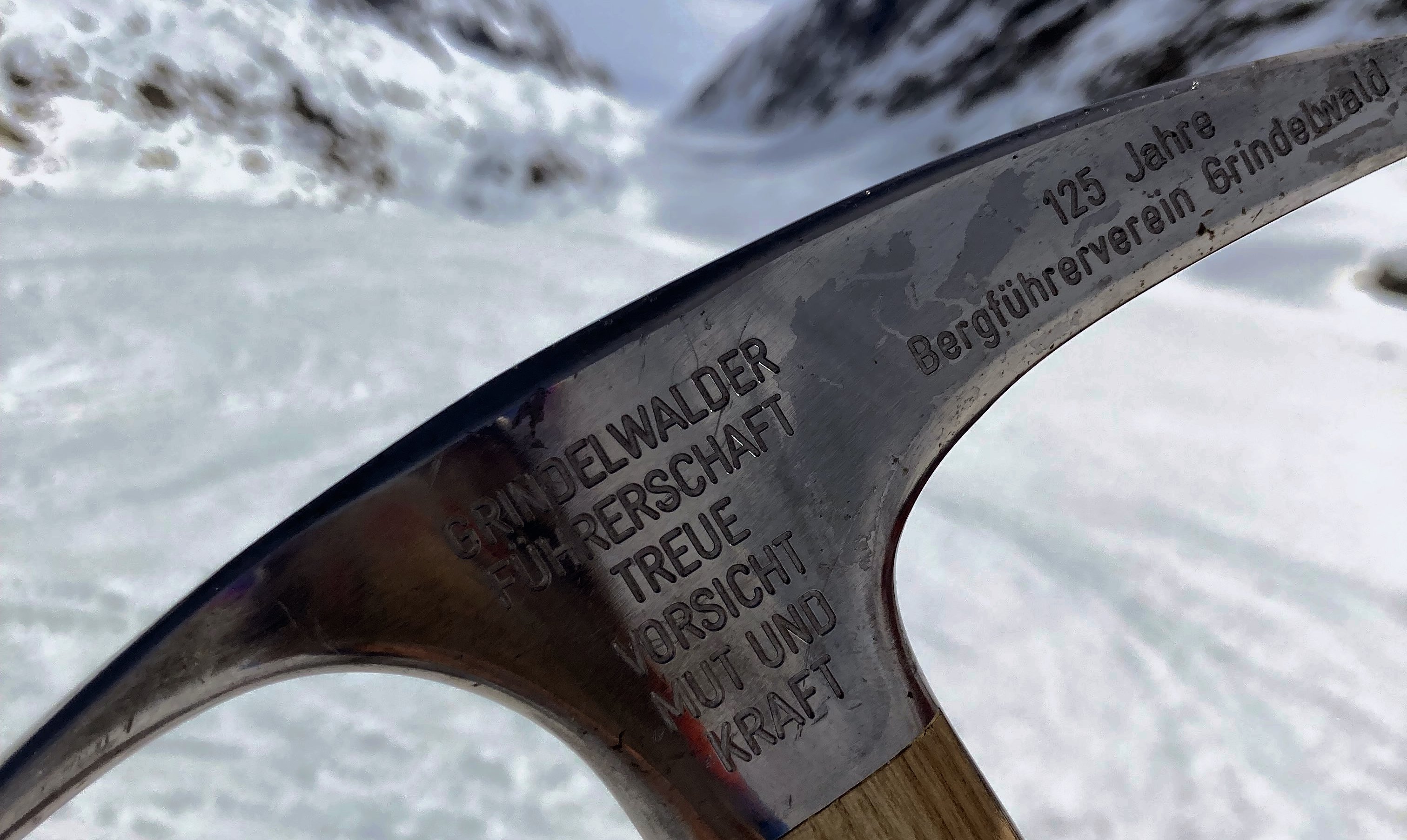
The association was organized as a professional guild. Its purpose: to promote the guiding trade and represent the interests of mountain guides. The motto established then still holds today:
Loyalty, Caution, Courage, and Strength
125 Years of the Grindelwald Mountain Guides Association
Our Huts
Grindelwald mountain guides have not only guided but also built.
Before permanent huts existed, natural shelters like the Gleckstein or Eiger Cave were developed into overnight camps. Later, mountain guides took the lead in constructing new huts.
These huts are part of our history:
- Berglihütte (1869)
- Schwarzegghütte (1877)
- Mittellegihütte (1924, rebuilt 2002 and 2019)
- Ostegghütte (1998)
- Mönchsjochhütte (1979, expanded 2004)
Today, the association owns three shelters: the Mittellegihütte, the Ostegghütte and the Mönchsjochhütte. They are maintained and cared for by mountain guides, not out of obligation, but out of conviction.
Our Partnership with OUTDOOR
The close collaboration with OUTDOOR is the result of years of development.
In 2002, the Mountain Guides Association and the Ski Instructors Association jointly founded GrindelwaldSports AG. The goal was to combine the expertise of both sides and professionally organize mountain and snow sports.
Over the years, the collaboration grew. In 2017, Jungfrau Sports Holding was founded, bringing together GrindelwaldSports and Outdoor Interlaken.
Since 2021, the organization operates under the name OUTDOOR Switzerland AG. Today, it runs the official Swiss Ski School Grindelwald, the OUTDOOR Mountain Sports School and over 250 activities related to mountains, water, and air.
Our members conduct tours, courses, and training there in both summer and winter.
The partnership combines our alpine experience with professional structures. This creates offerings that are not only safe and well-thought-out but also embody what the profession of mountain guiding is all about: real terrain, real responsibility, and real experiences.
The Mountain Guide Team

The Grindelwald Mountain Guides Association is led by active mountain guides. They advocate for the concerns of their colleagues and represent the association externally.
-> INSERT TEAM, BOARD, PRESIDENT, AND MOUNTAIN GUIDES HERE