Is Rafting on the Lütschine Safe for Beginners?
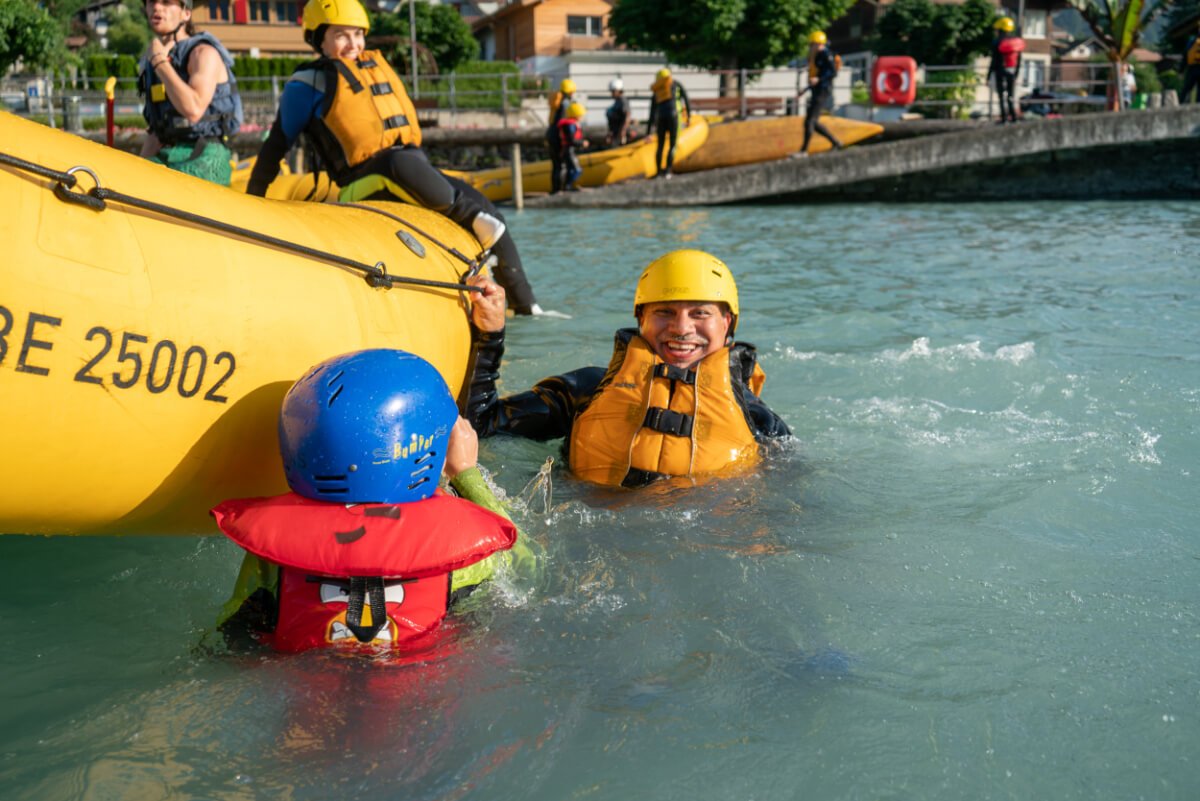
You don't need to have rafted before. That's the short answer.
The longer answer is more useful. The Lütschine is Class III-IV whitewater. That's not a beginner river in the sense that you can drift through it passively. It demands active paddling, it moves fast, and it doesn't slow down between rapids. What makes it accessible to first-timers isn't the difficulty level. It's the setup: professional guides, a thorough briefing, full equipment, and a safety kayak on the water at all times.
The one thing that is genuinely non-negotiable: you need to be a strong swimmer. Not a casual swimmer. A strong one. Here's what that means in practice, and why it matters on this specific river.
If the requirements don't fit you, that's not the end of the story. We have two alternatives that are real rafting but with different demands. More on that further down.
What Class III-IV Actually Means
Whitewater is classified on a scale from I to VI. Class I is flat water with minimal current. Class VI is considered unrunnable by most standards.
Class III-IV sits in the middle of the serious range:
Class III means irregular waves, narrow passages, and currents that require active maneuvering. You will get wet. You will need to paddle on command.
Class IV means powerful, predictable rapids with demanding lines. Scouting is sometimes necessary. Mistakes have consequences. This is where the Lütschine earns its reputation.
The important thing for first-timers to understand: Class III-IV doesn't mean dangerous if you follow instructions. It means the river is moving fast and you need to be present. The guides give clear paddle commands. You follow them. That's the job.
What it does mean is that this tour is not suitable for people who are uncomfortable in moving water, cannot swim confidently, or are looking for a relaxed float. If that's you, this isn't the right trip. If you're ready to work and get wet, you'll be fine.

The Swimming Requirement: What It Actually Means
The minimum age is 14. The maximum weight is 125 kg. And you must be a strong swimmer.
That last point deserves more than a checkbox. The Lütschine is a glacial river. The water is cold, the current is powerful, and in the unlikely event that someone exits the boat, they need to be able to manage themselves in moving water while the safety kayak reaches them. "Strong swimmer" means you're comfortable in open water, can swim against a mild current, and don't panic when submerged.
If you're a confident pool swimmer but have limited open-water experience, that's worth thinking about before you book. If you're a strong open-water swimmer, you meet the requirement.
The guides assess conditions on the day. In high water, particularly in early summer, the river runs harder. The requirement doesn't change, but the reality of what it means does.
How the Guides Make It Work for First-Timers
The briefing before you hit the water covers everything: how to hold the paddle, what the commands mean, what to do if you fall in, how to position yourself in the boat. It's thorough because it needs to be.
On the water, the guides run the show. They read the river, call the lines, and give commands in real time. Your job is to execute. First-timers consistently report that the structure of the tour makes it manageable even when the water feels intense. You're not figuring it out alone.
A safety kayak accompanies the entire tour. It's positioned to respond quickly if anyone exits the boat. The guides are trained in swift-water rescue. This infrastructure exists not because the tour is reckless, but because the river is real and the team takes it seriously.
By the time you reach Lake Brienz at the end and jump in for a swim, most first-timers have stopped thinking about whether they could handle it. They're just there.
When the Lütschine Isn't the Right Fit: Two Real Alternatives
The Class III-IV Lütschine isn't the only way to experience rafting in the region. We run two other tours designed for different conditions. Both are real rafting, both happen in the Swiss mountain landscape, and both have substantially lower requirements.
Family Rafting on the Lütschine
This is the lower, calmer section of the Lütschine. Class I-II, gentle waves, steady current. The route is suitable for kids and led by experienced guides. The tour also finishes with an optional jump into Lake Brienz.
Who it's for: Families with children, groups with mixed swimming abilities, anyone who wants to try rafting before stepping up to Class III-IV.
Key facts: 2 to 3 hours total, around 45 minutes on the water, May to September, departures at 14:00 and 16:00, from CHF 79 for kids and CHF 109 for adults.

River Rafting on the Simme
A different tour on a different river. The Simme runs through the Simmental valley, around 45 minutes from Interlaken. Gentle rapids, calm sections, scenic landscape with forests and meadows. Suitable for non-swimmers as well.
Who it's for: Anyone looking for a balanced mix of movement and nature, without the pressure of a Class III-IV river. Also ideal for families with younger teens who don't meet the Lütschine's minimum age of 14.
Key facts: 3 to 4.5 hours total (depending on meeting point), 1.5 hours on the water, May to mid-August (water-level dependent), departures at 08:45 / 12:45 / 13:45, from CHF 116.

How to Find the Right Tour for You
Honest decision guide:
If you... | the right tour is |
|---|---|
are a strong swimmer and want maximum intensity | River Rafting Lütschine (Class III-IV) |
are with kids or have mixed swimming abilities | Family Rafting Lütschine (Class I-II) |
want a more relaxed, scenic tour | River Rafting Simme |
are between 12 and 14 years old | Family Rafting or River Rafting Simme |
are a non-swimmer | Family Rafting or River Rafting Simme |
There's no point booking a tour that doesn't match you. There's also no point skipping rafting entirely just because one version doesn't fit.
For the full picture on the Lütschine tour from briefing to Lake Brienz, read our complete guide to River Rafting on the Lütschine.