Glacier crevasses – icy hell or magnificent natural spectacle
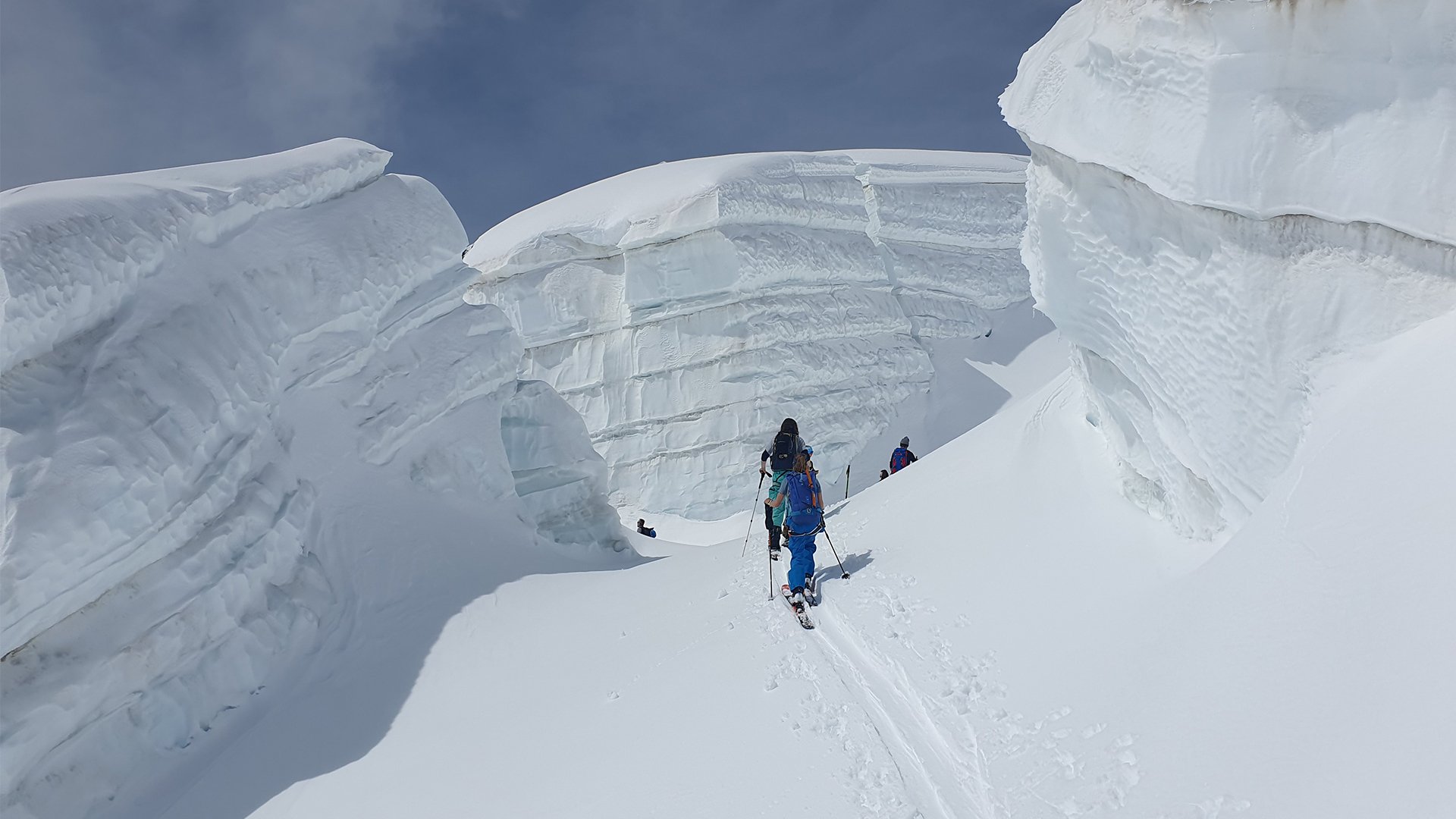
Glacier crevasses – icy hell or magnificent natural spectacle
The dangers on a glacier are diverse, as you are in an area where crevasses may be present, icefalls can occur, or poor visibility due to thick fog and snowstorms can lead to disorientation. Mountain guide and rescue specialist Ralph Näf shares his experiences and explains how to behave on a glacier.
How many crevasse falls occur in Switzerland each year?
According to the statistics of the Swiss Alpine Club (SAC), around 70 crevasse falls occurred in 2022. Compared to the years 2020 and 2021, this shows a slight upward trend.
Minor crevasse falls—those only a few meters deep or involving a companion rescue—are not included in these statistics.

What makes crevasses so dangerous?
The biggest danger is that crevasses often can't be seen. Fresh snow, poor visibility, or darkness can create situations where the risk is very hard to assess.
Are there advantages to crossing a glacier on touring skis compared to using crampons?
With skis, the load is distributed differently. Our body weight spreads across a larger surface due to the ski base, which means we sink in less. However, this effect should be approached with caution and not relied upon too heavily.
Can crevasses be expected in certain areas of a glacier? And are there areas where they can be avoided?
Important factors in crevasse formation include topography, the ground beneath the glacier, the glacier's path, and its flow movement and speed. It’s a complex interaction that, depending on these conditions, can lead to the formation of crevasses.
To explain this to my guests, I often compare it to a mountain stream: if the stream has little gradient, no bends, and a flat bed with no obstacles, it flows calmly into the valley. But if it has steep drops, twists, rocks, and uneven ground, the water becomes turbulent and foamy—just like a glacier in those conditions is more prone to crevasse formation.
How do you manage the risk of crevasse falls during a glacier tour?
Experience is key here. Choosing the right route, using a good strategy, and staying alert are crucial. I also make sure to inform my guests about proper behavior on the glacier.
How can crevasse falls be prevented?
Good self-assessment and awareness of the group's abilities are essential in preparing for a glacier ski tour.
A solid tour plan helps avoid unexpected challenges in the terrain that could lengthen the route and lead to time pressure. Under stress, decision-making and risk assessment can deteriorate.
I strongly recommend engaging more deeply with the tour rather than just downloading a GPX track from a website and following it. That might work well in nice weather with a visible trail. But if the weather turns, the track disappears, or darkness falls, it can end in disaster.
As a mountain rescuer, how do you respond when called to a crevasse fall?
We evaluate what resources and tools are needed for an efficient rescue. The terrain at the site has a big impact on how the rescue will unfold. Gaining an overview also allows us to assess other local hazards. This information analysis then leads to the final decision on which resources to use and which strategy to follow.
What equipment do you use for a crevasse rescue?
The equipment depends on the situation at the accident site. It ranges from improvised rescues using the gear every mountaineer should carry, to complex operations involving a tripod, compressors, generators, and much more.
What is the most common cause of death in a crevasse fall?
It is often a combination of mechanical injuries and hypothermia. A mechanical injury is caused by the fall. If the accident victim is trapped in the ice, they are exposed to intense and rapid cold. In such cases, it can happen very quickly.
What advice would you give to people who want to ski on a glacier?
Remember that the most dangerous crevasses are the ones we can't see, and there are thousands of them in the Jungfrau region alone. Assessing the risk of crevasses is just one factor to consider when ski touring on a glacier. Tour planning, ongoing assessment of the avalanche situation, and the human factor are still important.

My name is Ralph Näf. I work as a mountain guide, am president of Alpine Rescue Bern, and am a helicopter rescue specialist.


