Interview with Swiss mountain guide Freddy Grossniklaus
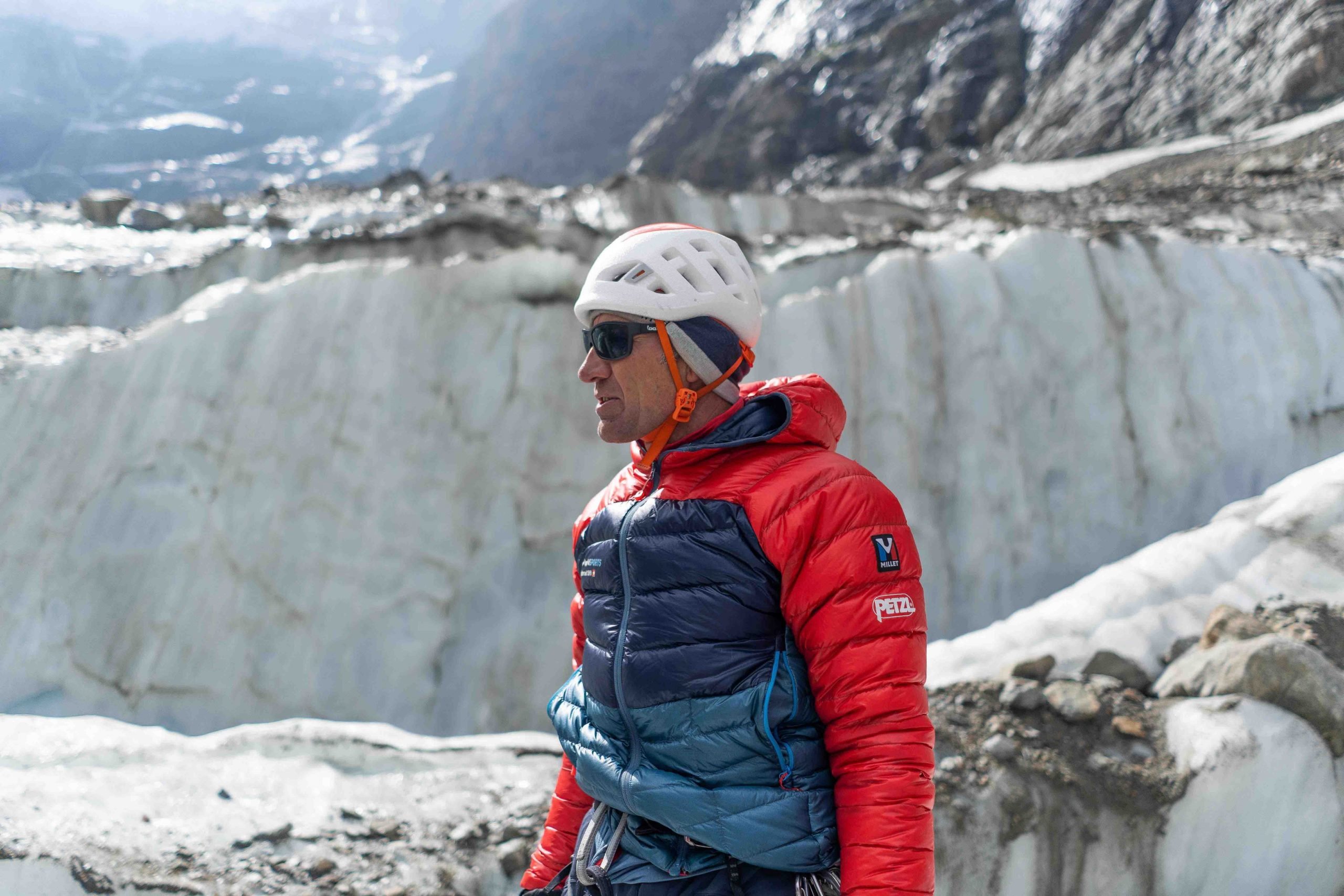
Interview: Freddy Grossniklaus
Where did you grow up, and how did that environment shape your childhood?
I grew up in a mountain village in Beatenberg. In a small room, but with lots of space outside to play, and to get wet and dirty. We often helped our grandparents clean the rabbit hutch, gather mushrooms or berries, do gardening, or cut wood. Since clothing back then wasn’t as good as it is today, it often meant getting wet. But we really learned a lot. Later, our father also took us on longer trips to look for mountain crystals. I caught the bug, and to this day, it has remained my hobby. Crystals are scattered all over the house.
You’ve been a mountain guide for thirty years. What particularly attracted you to this profession?
I’ve now been a mountain guide for thirty years. What attracted me to this job was the independence. You’re your own boss and don’t have to stare at your hammer somewhere on a roof from 7:00 AM to 6:00 PM. You’re outside in this breathtaking environment and get to engage with your guests and their stories, teach them things, share experiences – and at the end of the day, you know why you’re tired.
Another bonus: I’m still fit and healthy at 58 and don’t need to hit the gym in the evening.
How do you stay physically fit?
Well, sports too. For example, sport climbing, ski touring, and cycling. Searching for mountain crystals is also a hobby – sometimes I walk 8–9 hours and, if I’m lucky, carry a 50 kg backpack back. 😉
What do you think is most important for beginners in mountaineering?
A good basic education is important. The basic mountaineering course teaches fundamentals like knot techniques, walking with crampons or on a rope, and the correct use of an ice axe. Then it’s important not to set your goals too high too soon. That way, you can avoid tricky situations or resolve them appropriately. This is dear to my heart, because as an inexperienced boy, I simply had the luck to survive such moments. I want my guests to receive training appropriate to their level to avoid exactly those kinds of situations.
Can you tell us about a time when you saved someone’s life?
That was three years ago, when we were on our way to the Margherita hut at 4,500 meters above sea level. We had to find the hut using a compass because a cold front came in with a violent storm and we couldn’t see anything. At 10 PM, we decided to go to bed but then heard a cry for help through the open windows.
The three of us, fully geared up with ski goggles and crampons, decided to follow the call. After half an hour, we suddenly saw five people sitting on the ground. They were all perfectly equipped for the trip. But the storm came faster and stronger than expected, and they were too exhausted to continue and couldn’t reach the mountain rescue. We gave them tea and biscuits and led them one by one back to the hut. At the end, one woman hugged me and said, “You saved my life!” Had they stayed out overnight, they wouldn’t have survived.
Have you also had situations where you narrowly escaped an accident yourself?
A serious situation happened on the Mittelhorn. A guest and I had already been on the move for a while. At a steep spot, I secured the woman so she could descend. Once at the bottom, she thought she was almost on flat ground, started walking, slipped, and lost her ice axe.
Realizing the danger, I slammed my ice axe and crampons into the snow. Fortunately, I was able to hold her. I wouldn’t have died, but sliding 50 meters down a steep rock face with an ice axe and crampons is not pleasant for the body. A close call – all due to a misunderstanding.
Have you had dangerous experiences with poorly prepared guests?
One situation was with a Canadian who wanted to climb the Eiger, Matterhorn, and Mont Blanc with me in five days. Before the trip, I inquired about his experience via email and phone. According to his replies, he was perfectly prepared. Great, I thought, and met him at Kleine Scheidegg. He was waiting in Adidas sweatpants, sneakers, and with a massive backpack.
First, we ditched all unnecessary gear from his pack and started the tour. When we got to a large crevasse, I told him to wait briefly – but he just kept going and tripped right in front of the gap. He fell in headfirst. I had to use all my strength to hold him, in great pain. I knew if he fell, I would too. And we wouldn’t have survived. No one finds you there, and there’s no reception. That evening, I needed a big glass of schnapps – and couldn’t go back to the mountains for four days.
Have you ever met any famous people on your tours?
Quite a few. For example, Adolf Ogi while mountaineering, Daniel Craig during filming on the glacier for The Golden Compass, or Michael Jordan – while he was peeing. 😉
What makes Switzerland special as a mountaineering country?
It has everything you need for mountaineering, climbing, or ski touring. The huts are also well connected. From a single starting point, you can tackle demanding tours in no time. In America, for example, you have to carry your own food and tent.
Have you climbed peaks in other countries?
Yes, in America I’ve been to Alaska, Colorado, and the Cascades, among others. But also in New Zealand, Africa, and Europe I’ve climbed many mountains.
Which tour was the toughest for you?
24 days in Alaska, where we were on a glacier in an icy desert expedition-style at minus 45 degrees. We spent the time in tents that had to be cleared of snow every three hours. And when we moved, we went so slowly to avoid sweating – because sweating would mean frostbite.
What goals have you set for the future?
By retirement, I want to have guided all the 4000-meter peaks. I’m still missing Täschhorn, Gombin, Rimpfischhorn, and Lendspitz. Once I retire, I still want to lead the best tours – like the Aletsch Glacier hike. Our older guides still do great work at 70, and I want to do the same.
And what are you doing next?
First, I’m going to have a coffee.