Safety First: The Real Deal on Tandem Skydiving
Imagine plummeting towards the earth at 120 mph, surrounded by the snowy peaks of the Swiss Alps. It sounds insane, right? You might be asking yourself: Is this actually safe?
This article cuts through the adrenaline to look at what really matters when it comes to safety in tandem skydiving. We’ll talk about the preparation, the gear, and the people who make sure you land with a smile on your face.
Preparation is Everything
A lot of first-timers think skydiving is about throwing caution to the wind and leaping into the void. The reality couldn't be more different. Safety isn't an accident; it's the result of extreme preparation and standardized routines. Before you even set foot on the airfield, countless checks have already happened in the background.
We don't just "hope for the best." We prepare for everything.
Your Tandem Master: A Highly Qualified Pro
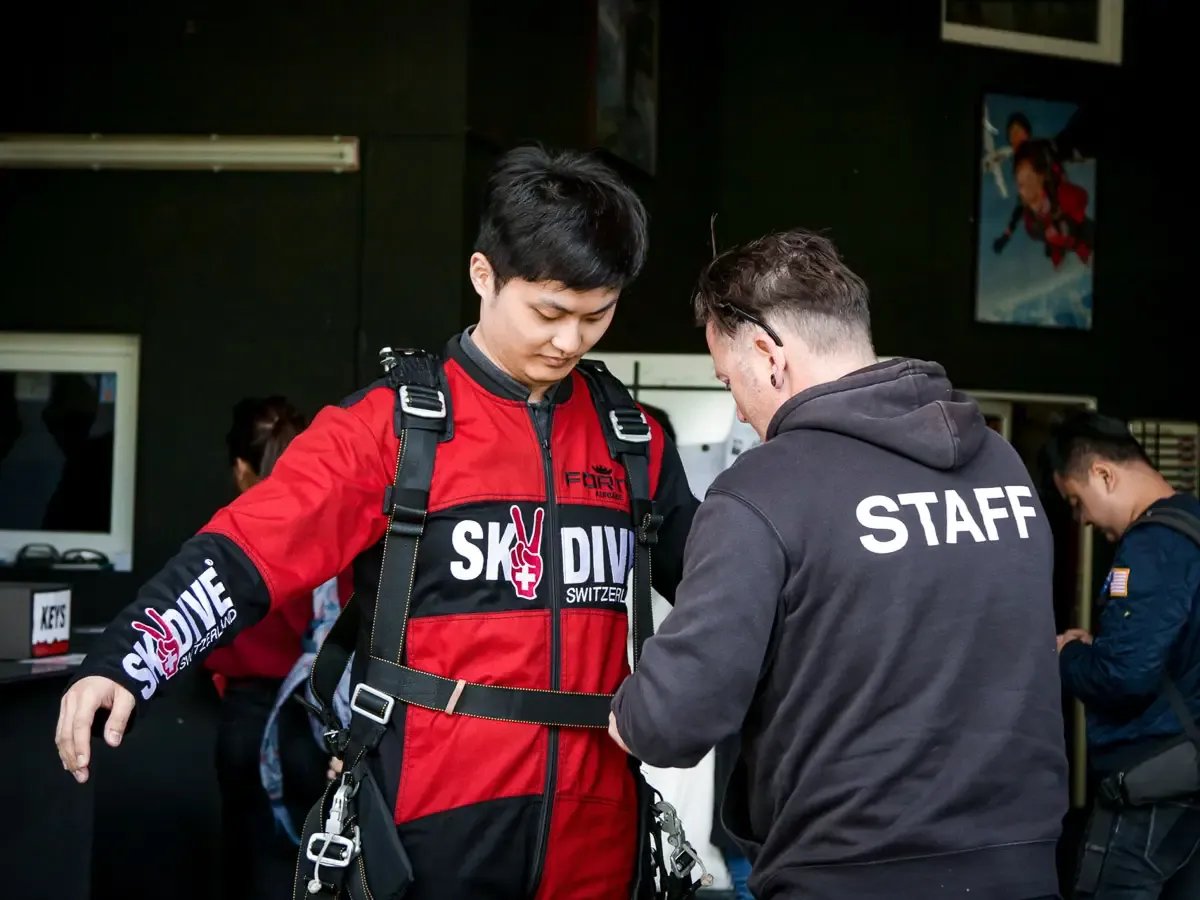
You never jump alone. Your tandem master isn't just an adrenaline junkie looking for a thrill; they are a highly qualified professional. To get this license, they have to jump over rigorous hurdles. We're talking about thousands of completed jumps before they are even allowed to take responsibility for a guest.
Every tandem master with us meets strict international standards, like those set by the USPA (United States Parachute Association) or Swiss Skydive. This includes regular medical checks and ongoing training. Our team members often have well over 10,000 jumps under their belts.
What does this mean for you? Situations that feel new and overwhelming to you are absolute routine for your guide. You are the "passenger," but your pilot knows every inch of this airspace.
Gear and Technology You Can Trust
Your trust hangs on the equipment. And here, there are no compromises. A modern parachute system for tandem jumps is a technological masterpiece built on redundancy. That means everything important is there twice.
Two Is Better Than One
Every system has a main parachute and a reserve parachute. If the main chute doesn't open perfectly for any reason, there is an immediate backup.
The Computer Guardian
Additionally, every rig is equipped with an AAD (Automatic Activation Device). This is a small computer that constantly measures pressure and fall speed. If the tandem master doesn't open the chute at a certain altitude—for whatever reason—this computer automatically fires the reserve chute.
Also, the chutes aren't just packed "any old way." The packing of the reserve chute can only be done by specially licensed riggers and is subject to strict maintenance schedules.
Protocols and Standards
In Switzerland, jumping operations follow the strict rules of the FOCA (Federal Office of Civil Aviation). We don't operate in the Wild West; we work in a highly regulated aviation environment.
Certifications and Regulations
Every skydiving operation is audited. This affects not just the parachutes, but also the planes and helicopters. Our Cessna Grand Caravan or the helicopters from Air-Glaciers are maintained according to strict schedules. The pilots are specially trained for drop operations.
There are clear rules for the airspace. We are in constant contact with air traffic control (Skyguide) to ensure our airspace is clear. These invisible protocols minimize risk before the propeller even starts turning.
Emergency Plans
Even though we almost never need them, there is a plan for every scenario. In the plane, before takeoff and during the climb, we mentally review "Emergency Procedures." Your tandem master knows exactly what to do if the plane has issues or if the parachute opening doesn't go to plan.
These procedures are practiced until they are muscle memory. For you as a guest, this means you don't have to make decisions. Your job is to enjoy the experience while the pro on your back covers all bases.
Managing Risk in Winter
Winter in the Alps offers a breathtaking backdrop, but it brings its own challenges. Safety here means, above all, respecting nature.
Weather Calls
The weather is the only factor we can't control. But we can evaluate it. And here’s the rule: Safety always comes before profit. A cancellation might be disappointing, but it's a sign of a quality provider.
It doesn't matter if the sun is shining on the ground. What matters are the wind speeds at 13,000 feet and the cloud base. Strong high-altitude winds can make drifting unpredictable. Thick cloud layers can block visibility during opening. If we say "No Go," it's because we want you to land safely.
Winter Gear
Cold can be a safety risk if it limits movement or focus. At 13,000 feet in winter, it's about 45°F (25°C) colder than on the ground. That's why we make sure you stay warm without restricting your movement. Gloves are mandatory, as are closed shoes. Goggles protect your eyes from the icy wind at 120 mph.
Your Role in Safety
Safety is teamwork. Even though the tandem master carries the responsibility, you have an active role as a guest.
Health and Fitness
We don't ask for your weight to be nosy. The limits (max 230 lbs / 105 kg for the plane, 210 lbs / 95 kg for the heli) are physical limits of the gear and crucial for a safe landing.
There is also zero tolerance for alcohol and drugs. You need a clear head. While you don't need to be an Olympic athlete, a basic level of fitness helps. You should be able to lift your legs for the landing. If you have heart, circulation, or back problems, please clear this up beforehand.
Listen to the Briefing
Listen closely to the briefing. It's short, but vital. There are three key moments:
- The Exit: Head back, hands on the harness, hips forward (the "Banana").
- Freefall: Enjoy it and stay stable.
- The Landing: Legs up!
If you follow these simple instructions, you make your tandem master's job much easier and the jump safer for everyone. Don't try to "steer" in freefall or run along during landing unless told to. Trust your guide.
Conclusion
Tandem skydiving is a high-adventure environment made into a low-risk activity by professionals, technology, and standards. We don't ignore the danger; we manage it. When you step into the plane in Interlaken, you can be sure: the risk is calculated, the gear is checked, and the partner on your back knows exactly what they are doing.
Your only job is to breathe, marvel at the view, and experience the moment over the Alps.
Ready to brave the cold? Learn exactly how to prepare for the temperatures here: [What to Wear: A Practical Packing List]
