Scared to Jump? Why Fear is Normal (and How to Beat It)
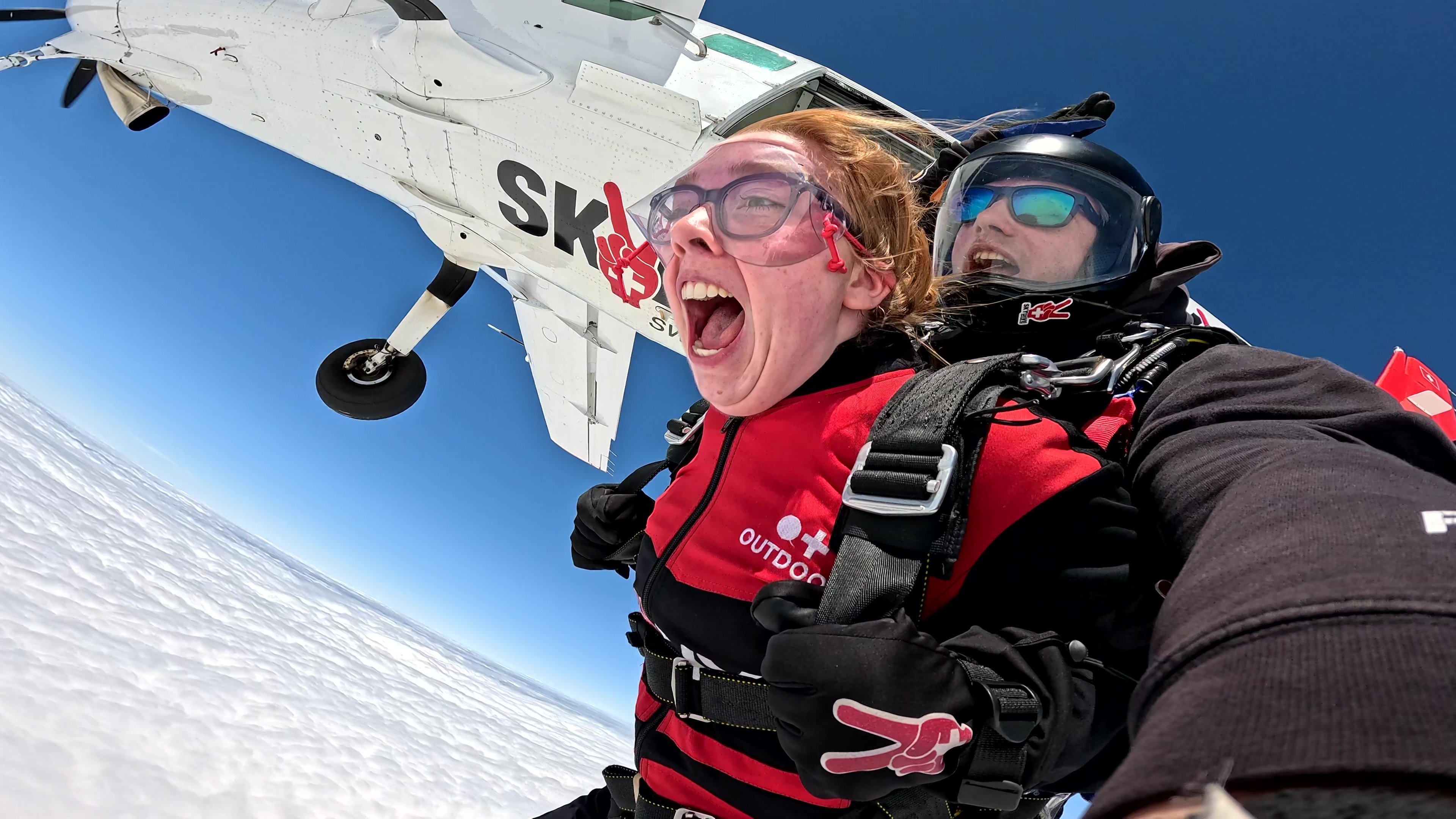
Have you ever stood at the edge of a cliff, looked way down, and felt your stomach do a somersault—even though you knew you were perfectly safe? That hesitation is deeply human. It’s a sign that your instincts are working exactly as they should.
When it comes to a tandem skydive from 13,000 feet, that feeling isn’t a roadblock. It’s the fuel that makes the experience so unforgettable.
Why We Feel the Fear
First things first: being nervous doesn't mean you can't do this. In fact, your body is reacting exactly right. Let’s look at where this feeling comes from. When you understand the "enemy," you can defeat it.
The Alarm in Your Brain
Deep in our brains, there's an ancient program designed to keep our ancestors from falling out of tall trees. When you stand at the open door of an airplane, every fiber of your being yells, "This is not a good idea!"
Evolutionarily speaking, freefall is a red alert situation. Your body floods your system with adrenaline to prepare you for fight or flight. In skydiving, we take that massive surge of energy and redirect it. We don't run away; we jump.
Letting Go of Control
Most of us are used to being in charge—at work, in sports, in daily life. But on a tandem jump, you have to hand over the reins completely. You are strapped to a tandem master you might have met only 30 minutes ago.
For people who like to be in the driver's seat, this loss of control is often scarier than the height itself. You are a passenger in an extreme situation. Trusting someone else is your first step out of your comfort zone.
Forget What You Saw in the Movies
Hollywood has been lying to us for years. In movies, lines snap, people have casual conversations in freefall (which is physically impossible due to wind noise), and drama always trumps reality.
We store these dramatic images in our heads. But the reality of modern skydiving is a world of redundancy, high-tech gear, and strict safety protocols. Knowing the truth helps you delete the fiction from your mind.
Tools to Conquer the Nerves
Courage isn't the absence of fear; it's the decision to do it anyway. Here are some tools that we use ourselves and that have helped thousands of our guests.
Knowledge is Power
The unknown is scary. But as soon as you know exactly what happens step-by-step, the monster under the bed disappears. Your brain can categorize the situation.
Ask us anything. Seriously. Our crew in Interlaken does this every single day, and we love explaining the details. When you know the roadmap—from the gear-up to the landing—the overwhelming task breaks down into small, manageable steps.
Your Tandem Skydive: A Step-by-Step Guide
Breathe Through It
When we get scared, we breathe shallow and fast. This signals stress to the body. Science shows we can flip this switch. Slow, controlled breathing acts directly on your nervous system to calm you down.
Try this on the ground or in the plane:
- Breathe in deep through your nose (count to 4).
- Hold it for a second.
- Breathe out very slowly through your mouth (count to 8).
Repeat this. You'll feel your pulse slow down. Combine this with visualization. Don't picture the fall; picture the feeling after the landing. Imagine standing on the grass, looking back up at the Alps, bursting with pride.
Facts vs. Feelings
Sometimes your head needs cold, hard facts to calm your stomach. The safety standards in skydiving are incredibly high.
- Training: Every tandem master has undergone extensive training and exams, with thousands of jumps required before they can ever take a guest with them.
- Technology: Every system has a main parachute and a reserve parachute. Plus, there is a mandatory computer called an AAD (Automatic Activation Device) that automatically opens the reserve if the jumper doesn't.
The Point of No Return
The hardest part often isn't the jump itself—it's clicking "Book Now." As long as you say "I'll do it someday," the fear remains abstract. Once you have a date, it gets real.
Book your slot. Tell your friends. Make it binding. That little bit of social pressure is often just the nudge you need to keep from backing out at the last minute.
The Jump Itself
You've prepared, you're in the plane, and Interlaken is getting smaller below you. Now it gets real. And that's a good thing.
The Moment at the Door
This is the peak of the tension. The door opens, cold air rushes in, and the noise level jumps. Your heart will race. This is the moment to remember your briefing: Head back, hips forward (the "banana" shape).
You don't have to make any decisions now. You are securely connected to your instructor. They do the work. Your only job is to let go.
Freefall: Not What You Expect
Many first-timers expect a stomach-dropping sensation, like a rollercoaster plunging down. But that doesn't happen.
Because the plane is moving forward, you simply transition onto a cushion of air. Within seconds, you reach your cruising speed. The feeling of "falling" vanishes and turns into a feeling of "flying" or floating. It’s loud, it’s intense, but your stomach stays put. You are completely in the here and now. No taxes, no emails, no worries. Just wind and the view.
The Landing and The High
Once the parachute opens, silence returns. You glide over the Swiss Alps, seeing the Eiger, Mönch, and Jungfrau from a perspective usually reserved for eagles.
When you land, something magical happens: All that built-up tension releases in a wave of pure euphoria.

Conclusion
Being scared of the jump is no shame. It shows you have respect for the forces of nature and the altitude. But don't let that fear stop you from having perhaps the most intense experience of your life.
The fear stays in the airplane. What lands with you is a new confidence and the knowledge that you are braver than you thought.
Are you ready to leave your comfort zone behind? We'll be right there with you.
