Weather in Interlaken: what you need to know
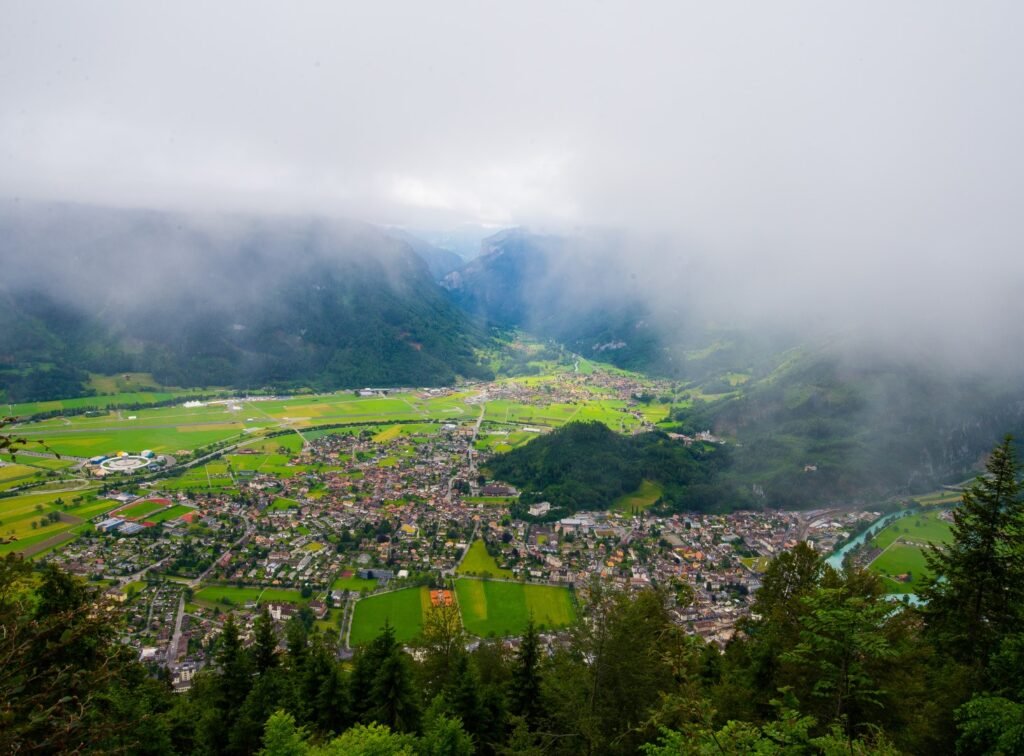
You're just arrived in Interlaken, there's a grey lid over the valley, and your activity is booked for 2pm. The question that comes next is one we hear daily: is that it, then?
Usually not. Most of what we run happens in the rain anyway, and some of it is better for it. What looks like a lost day down in the valley can be blue sky 1500 metres higher up.
The short version
- Weather in the valley tells you very little about weather on the mountain
- Forecasts here are reliable for about two days, not more
- Use MeteoSwiss and Meteoblue, not international apps
- We decide on the day itself and call you or message you on WhatsApp
- If we cancel, you choose: rebook, switch activity, or full refund
Jump to: Understanding the weather · Forecasts · Cancellations and refunds · What runs in which conditions · Gear · Rainy day options · FAQ


Why the weather here works differently
Interlaken sits at 570 metres above sea level, between two lakes, surrounded by mountains. Less than 20 kilometres south stand the Eiger, Mönch and Jungfrau, and behind them peaks above 4000 metres. That much altitude across that little distance creates its own weather.
It flips fast, in both directions. A shower passes through, an hour later the sun is over the valley. Or a clear morning closes in by midday. Stay three days here and you'll rarely get three of the same.
Fog in the valley doesn't mean fog on the mountain. In autumn and winter especially, a layer of high fog sits over Interlaken while Schynige Platte, First and Schilthorn are in full sun and you're looking down at a sea of cloud. If the valley is grey: go up.
The föhn gets involved. This warm downslope wind from the south can lift the temperature within hours and tear the sky open. It also brings strong gusts, which mainly affect anything in the air or on the water.
Yesterday's weather still counts today. Heavy rain swells streams and rivers. That can stop a canyoning tour the following day even in bright sunshine. With rafting it's the opposite: more water usually means more of a ride.
In winter, add snow line, avalanche conditions and lift operations. In heavy snowfall or elevated avalanche danger, our mountain guides adjust the tour plan or move to a different area.
How to read the forecast
The most common disappointment here isn't caused by the weather. It's caused by the weather app.
International forecast services run global models with a grid width of several kilometres. On flat terrain that works well. In an alpine valley that packs 3000 metres of altitude into a single grid cell, it doesn't. The app gives you an average of valley floor and summit, and that's accurate for neither.
These are the sources we use:
MeteoSwiss is the official Swiss weather service. Fine model grid, reliable warnings for thunderstorms, wind and heavy rain. Free, and the best baseline for Switzerland.
Meteoblue gives point forecasts with a meteogram and shows how much the different models agree. When they diverge, you know the forecast is uncertain. That's more honest than a single sun icon.
SRF Meteo for the bigger picture and the days ahead.
Webcams are the reality check. Harder Kulm, Grindelwald First, Schilthorn and Jungfraujoch show you what it actually looks like right now. Five seconds of webcam beats any forecast.
The two-day rule: even good forecasts are only reliable about two days ahead in this terrain. Anything beyond that is a tendency, not a statement.
So build in a buffer day and put weather-critical bookings like skydiving early in your stay. Availability for each day is shown directly on the activity page.
How we decide in bad weather
What we run depends on conditions. Here's how the process works, so you know where you stand.
1. We watch continuously. Our mountain guides, canyoning guides, tandem pilots and boat skippers track the development constantly, along with water levels, wind forecasts and, in winter, avalanche conditions.
2. The call comes as early as possible, but often only in the morning. For some activities a reliable assessment isn't possible until the day itself, sometimes only a few hours before the start. A forecast 24 hours out would frequently just be wrong here. We'd rather cancel late and correctly than early and unnecessarily.
3. We contact you by phone or WhatsApp. Which makes this the most important line on the page: when you book, give us a number you can actually be reached on in Interlaken. Check your roaming and data connection.
4. No call means it's on. If you don't hear from us, your activity is running as planned or the decision is still open. When in doubt, show up at the meeting point at the agreed time.
5. If we can't run it, you choose. Rebook for another date, switch to a different activity, or get a full refund.
6. We can also stop mid-activity. If conditions deteriorate along the way, the team on site decides. Safety comes first, always. We then look for an alternative or adjust the programme.
For partner activities, their procedures apply. Paragliding and hang gliding are booked through partner operators whose tandem pilots decide on their own operations and contact you directly.
If you want to cancel yourself: free cancellation up to 48 hours before the start, and up to 30 days before for mountain sports and outdoor events. Details are in our terms and conditions. Cancellation insurance is down to each guest and generally a good idea.
What runs in which conditions
There's no blanket answer, because every activity reacts to something different. It isn't always the rain. Often it's wind, visibility or water level.
Water activities run almost always. Rafting on the Lütschine and Simme, canyoning and jetboat all run in the rain. You're in a wetsuit and wet regardless. Thunderstorms are the limit, and for canyoning, water level: after heavy rainfall a gorge can be closed even in full sun. For rafting, more water is usually a gain.
Skydiving needs clear conditions. No jump operations in rain, low cloud, or strong and gusty wind. The cloud base is what decides: there has to be enough height between exit and cloud, plus a clear view of the landing zone. That's exactly why the call can come so late here. A stable gap in the morning is sometimes enough while the afternoon is cancelled.
Bungee jump, canyon swing and ropes park react to wind and thunderstorms. Light rain is no issue. Strong wind and lightning are.
On rock, moisture decides. Outdoor climbing and via ferrata need dry rock: wet rock means less friction and more risk, plus lightning exposure in open terrain. These tours drop out faster than water activities.
In high alpine terrain we postpone rather than improvise. Glacier walks, summit tours and high alpine ascents depend on visibility, orientation, crevasse safety and a reliable weather window. In poor conditions we usually cancel or move these tours to a date with a better forecast. Pushing through a tour with no visibility is neither safe nor good, so we don't.
Hiking works in almost any weather. With the right gear, rain isn't an obstacle. We adjust for thunderstorms or when visibility limits the route choice.
In winter, avalanche conditions decide. Snow sports lessons and sledging run fine in snowfall, that's the normal case. For ski touring, freeriding and snowshoe tours, the avalanche situation determines route and area. Ice climbing also depends heavily on how temperatures develop.
Indoor and the gorge always run. Glacier Gorge Grindelwald, the Indoor Ropes Park Grindelwald and indoor climbing are weather independent.
OUTDOOR Adventures Interlaken
What's better in the rain
Rafting. Higher water, stronger current, bigger waves.
Canyoning. You're in a wetsuit, in the water, in a gorge. Whether it's raining above you stops registering after five minutes.
Glacier Gorge Grindelwald. More rain means more water in the Lütschine, and the gorge gets louder and more impressive.
Hiking in fog. Empty trails, soft light, forest that smells different. Quieter than any sunny day.
Gear that works
Layers beat one thick jacket. Three thin layers are warmer, drier and more flexible than one heavy one. You can regulate instead of sweating or freezing.
No cotton. It soaks up water, dries slowly and chills you. Synthetics or merino dry fast and keep warming when damp.
A hardshell belongs in your pack. Light, packs down small, windproof. It's the item used least often and missed most painfully.
A rain cover for your pack, or at least a dry bag inside for phone, power bank and spare clothes.
Spare clothes in the car or at the hotel. After a wet activity, dry clothing is worth more than any souvenir.
Shoes that match the activity. For mountain sports: ankle height, good tread, broken in. New boots on day one are a bad idea.
For most water activities we provide wetsuit, helmet, buoyancy aid and shoes, and for mountain sports tours the technical equipment. What you need to bring yourself is listed on each activity page. Anything missing you'll find at our Millet Store in Grindelwald, including winter rental gear.
What to do in Interlaken when it rains
Bookable and rainproof: rafting on the Lütschine or Simme, canyoning, jetboat, Glacier Gorge Grindelwald, the Indoor Ropes Park Grindelwald and indoor climbing.
And if you're filling a day with no programme:
- Go up. With high fog in the valley, the trip to Schynige Platte, First, Schilthorn or Harder Kulm is often the best move of the day.
- Take the train. The routes through the Bernese Oberland and over the Brünig are worth it in the rain too. -> Timetable
- Swim. Indoor pools and spas across the region.
- Eat. Cheese dairy, chocolate, long lunches. -> Funky Chocolate Club
- Museums and towns. Ballenberg, Thun and Bern are all within reach.