50 years Lötschenlücke
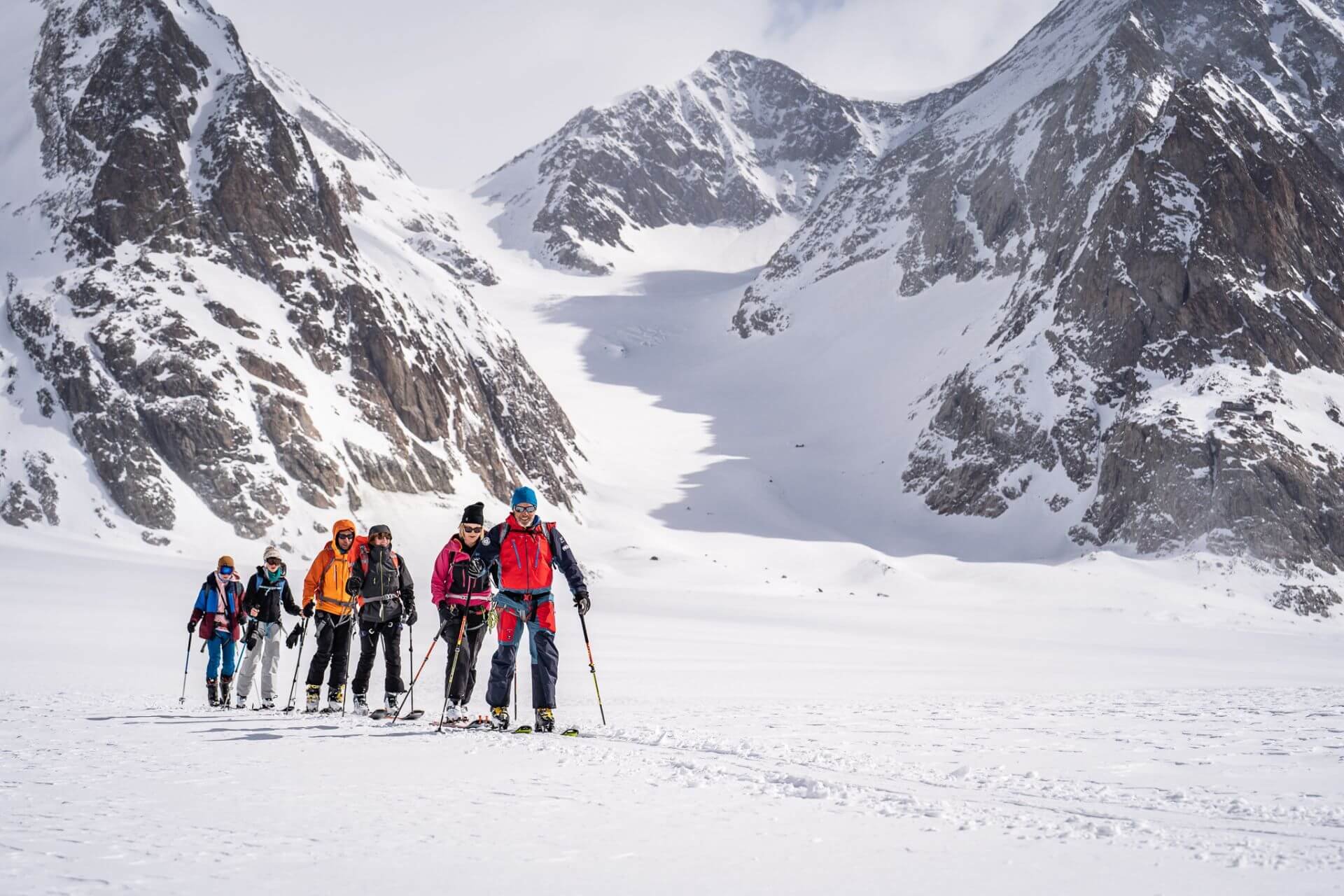
On the Lötschenlücke for 50 years
Interview with Mountainguide Marco Bomio
In what year did you do your first Lötschenlücke tour?
I first crossed the Lötschenlücke at the age of 18 (in 1972) with friends from the JO Blüemlisalp. As an aspiring guide, I led the tour for the first time in 1978.
What has changed on the tour over the past 50 years?
The changes are mainly due to climate factors. This is evident in the fact that the glacier has sunk significantly in several places. The elevation of the pass is now 25 meters lower than it was 50 years ago. In the valley, the glacier has retreated by about one kilometer. Due to the flattening of the glacier tongue, descending from the glacier above the Fafleralp is now considerably easier.
How has the descent toward Fafleralp changed?
It has become somewhat trickier in parts. Rising temperatures and the thawing of permafrost cause ice and rock to fall from the slopes on the left-hand side. As a result, correct route choice has become increasingly important.

Marco Bomio – Mountainguide from Grindelwald

How does a winter with little precipitation affect the conditions of the tour?
In the winter of 1989/1990, the weather was fine and dry with no precipitation all the way into February. Most ski resorts were unable to open. Back then, the Lötschenlücke offered an ideal alternative. We led the tour almost daily. This shows – and we can observe the same today – that glacier conditions for ski touring are less influenced by the amount of winter precipitation. The wind usually brings enough snow onto the glacier. Whether this will remain the case in the future remains to be seen.
How has the guest clientele changed?
Overall, the level of ability has increased – people are fitter and, of course, they have much better equipment. In addition, the availability of information regarding weather and conditions has greatly improved thanks to digitalization.
As a result, ski tourers are more likely to undertake the Lötschenlücke tour independently nowadays. In the past, it was perceived as a very demanding tour, especially because such information wasn’t accessible. For that reason, most people only did it with a professional guide.
Even today, however, it is advisable to do the tour with a mountain guide. Beyond the safety aspect, guests gain added value, as the guide can best read the terrain and find the most beautiful, untouched slopes. Especially during the descent, this can benefit the guest greatly and make the experience all the more enjoyable.

What skills and experience do I need to participate in a guided tour over the Lötschenlücke?
Guests must be able to perform a reliable stem turn even in difficult conditions and should have good physical fitness. The problem is often that the descent to Blatten is underestimated. It’s very long, and the conditions are almost always challenging at some point (e.g., breakable crust).
That’s why it’s important to have some prior experience and to have already done one or two ski tours.
Any final thoughts?
It’s still a magnificent ski tour. Especially for people who haven’t done many tours yet, it’s very well suited. You get to see all nine 4000-meter peaks of the Bernese Alps!
As a follow-up, I always recommend the ski tour “over the Bächilücke.” It’s comparable to the Lötschenlücke in terms of physical and technical demands, but it takes two days – so it’s already a step up.

